
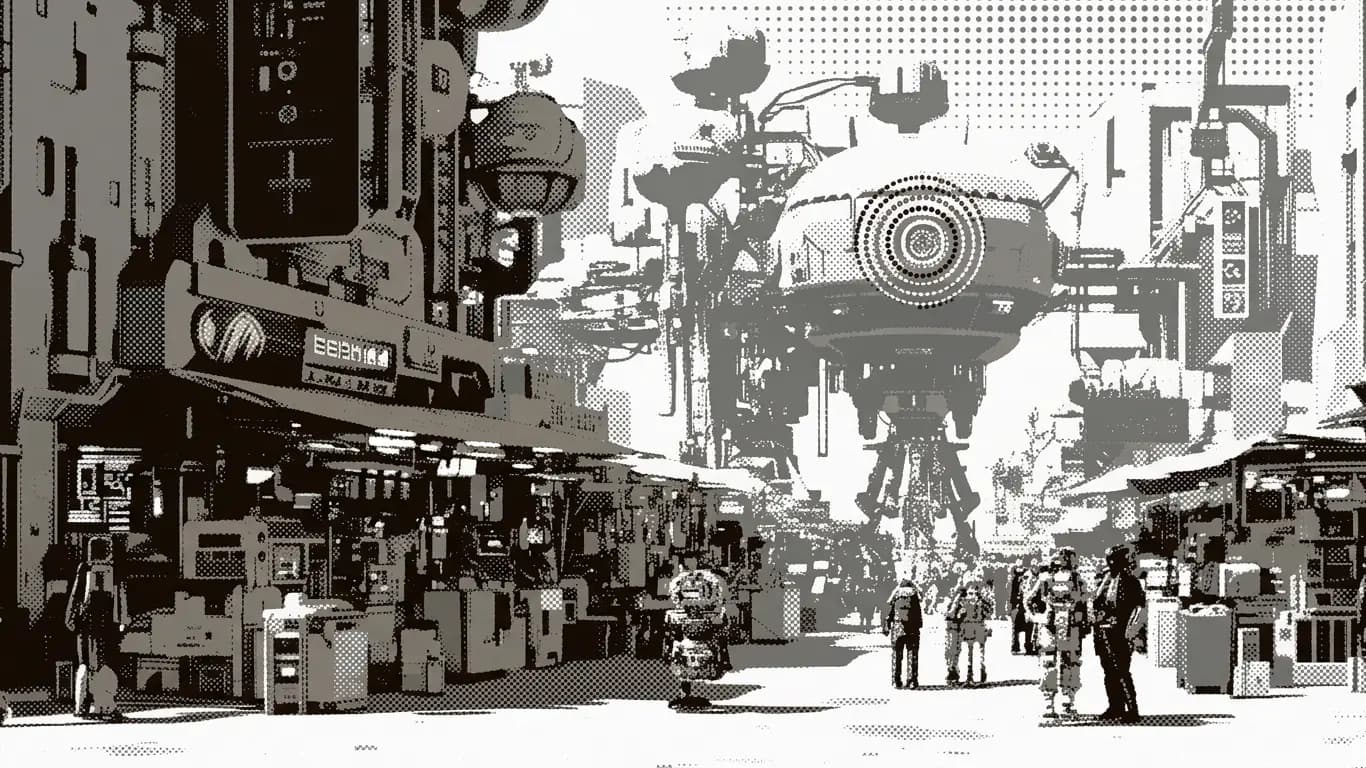
Google's grand bazaar
Google I/O 2026 launched Gemini 3.5 Flash, Omni, Spark and Antigravity 2.0 alongside dozens of other AI products. Google has nearly every asset to lead the next phase of AI, but still struggles to converge on a coherent product spine.

Joel Miller
Google I/O 2026 was the biggest AI event of the week, and probably the fullest expression yet of Google's AI strategy. Gemini 3.5, AI Mode, Gemini Omni, Spark, Antigravity 2.0, Beam, Android XR glasses, new Workspace features, new creator tools, new silicon, new subscription tiers. Google has almost every asset it needs to lead the next phase of AI. But it's yet to show that it can turn those assets into products many people trust.
The main model news was Gemini 3.5 Flash, now the default model in the Gemini app and AI Mode in Search. We've been running Gemini 3.5 Flash in daily work since launch. It's fast, and the output quality holds up against pricier tiers for most everyday tasks.
Gemini Omni is the deeper play. Google describes it as a natively multimodal generative model that can take any combination of text, image, audio and video as input and produce coherent output. Video is the launch modality, with image and audio promised later. Sundar Pichai framed it as a step towards world models that can simulate physics, culture and causality, which is straight from the DeepMind playbook on spatial intelligence and embodied understanding.
We don't buy the full "any-to-any" branding yet. Output is video-only at launch, and Veo and Imagen still exist as parallel specialist systems. GPT-4o followed a similar pattern: the "o" stood for omni, but the full omni capability never quite arrived. The bet behind Omni is still the right one. If the next jump in machine intelligence comes from training on the physical world rather than scaling text alone, Omni is Google's production test of that thesis. Google is the company best placed to run it.
Gemini Spark may matter more than it looked on stage. It is a 24/7 background agent running on Google Cloud VMs, integrated with Workspace, and consumer services like Canva and Instacart. You can think of it as a simpler version of OpenClaw.
After those three topics, the event became harder to parse. Universal Cart promised cross-merchant checkout across Search, YouTube, Gemini and Gmail. Beam with Sophie put a lifelike video AI agent inside what used to be Project Starline. Search gained generative UI, a redesigned intelligent Search Box and more AI Mode surface area. Workspace added Gmail Live, Docs Live and Keep Live for voice-driven work. Pics arrived as a Nano Banana 2 powered editing surface. There was Daily Brief, Ask YouTube, Ask Maps, Flow for music and video creation, Googlebooks as a new Android laptop category, four Android XR glasses partnerships, TPU 8t and 8i silicon, and AI Ultra subscription tiers at $100 and $200.
Each announcement is defensible on its own. Together they gave the familiar Google feeling: extraordinary capability, too many fronts, and not enough evidence that the teams are converging on a single intuitive product spine.
The strongest consolidation was in developer tooling, where it matters most for AI coding. Antigravity 2.0 pulls together the original Antigravity, Gemini CLI and Jules onto a shared engine, with the new CLI and the app as the two surfaces. Strategically, that's the right move. Tactically, the migration damaged trust. We were Antigravity 1.0 users. The 2.0 update auto-installed, then failed to authenticate, and once that was fixed we found the IDE mode we relied on had been removed in favour of an agent-only experience. Google hurried an IDE option back in, and provided free tokens to users, but the damage was done.
Takeaways: Google I/O 2026 showed a company with almost everything required to lead the next phase of AI, and not yet enough discipline to make the whole thing feel coherent. Gemini 3.5 Flash proves Google can ship a fast, capable model at scale. Omni puts DeepMind's world-model thesis into production. Spark shows that Google understands agents change computing from sessions to standing instructions. Antigravity 2.0 shows that Google can consolidate when it chooses to, but the migration pain shows how easily it can lose user trust. The bazaar is open and the merchandise is real. The next test is whether Google can close a few stalls and make the best ones indispensable.