


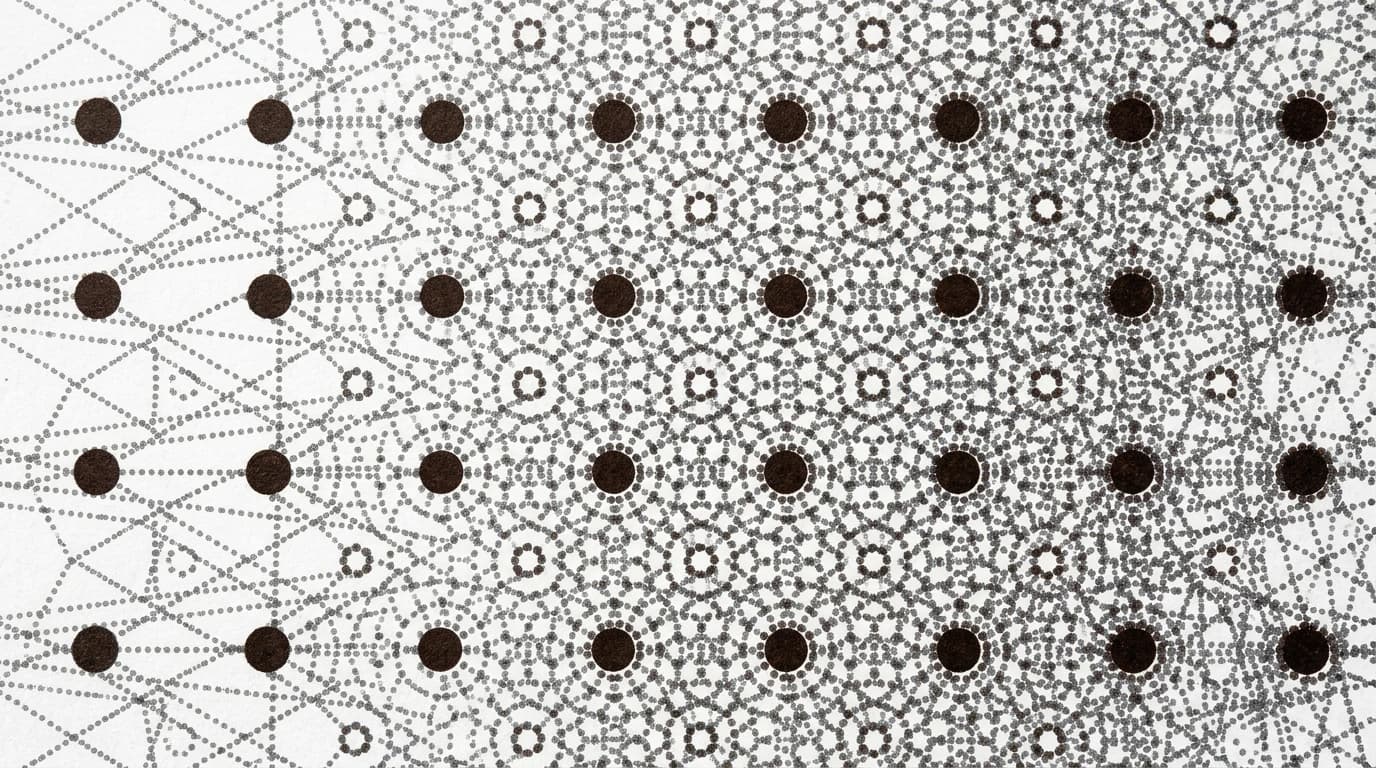
This is a grid of dots, laced with lines of equal length, and it's how mathematicians pictured Erdős's unit distance problem for 80 years. Everyone assumed the densest answers looked like grids. They were wrong.
An OpenAI model disproved the conjecture, and it did so by ignoring the picture entirely. It recast the geometry as algebraic number theory, built a high-dimensional lattice, then projected it down to the plane. The dots were only ever a shadow of something living in abstract space.
You might read this as a comment on AI's missing world models, its weak spatial sense. Perhaps. But the more honest reading is the reverse. The AI won precisely because it carried no visual prior. It saw numbers where humans saw dots, and the metaphor that anchored a field for decades simply didn't bind it.
AI's edge may lie not in seeing better, but in not seeing at all, translating problems across domains where our default spatial intuitions quietly hold us back.