



Water footprints in context
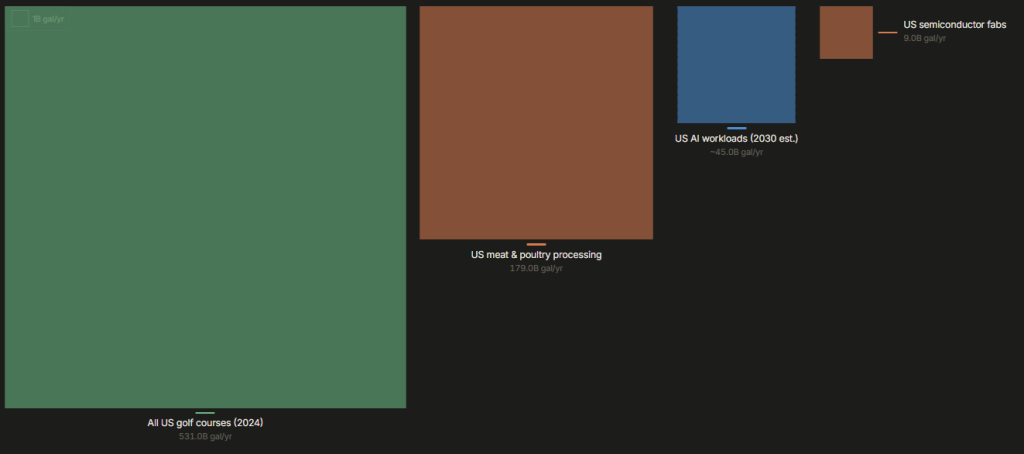
The chart this week comes from Andy Masley, a researcher who has spent the past year challenging claims about AI’s environmental footprint. His interactive visualisation compares US water consumption across industries using public supply (potable) water. US meat and poultry processing consumes 108 billion gallons per year. All US golf courses drink 48 billion. Semiconductor fabs use 9 billion. And all US AI workloads? And all US AI workloads projected to use 45 billion by 2030.
But experts caution against dismissing concerns outright. “In the near term, it’s not a nationwide crisis,” says Cornell professor Fengqi You. “But in locations that have existing water stress, building these AI data centres is gonna be a big problem.” Jonathan Koomey, a leading researcher on data centre efficiency, agrees: “Each situation has to be evaluated in the context of the specific design of the facility being proposed.”
Weekly news roundup
AI business news
- Astral to join OpenAI (The creators of uv and Ruff — now foundational to modern Python development — joining OpenAI’s Codex team is the clearest signal yet that AI coding assistants are acquiring the developer tooling layer, not just wrapping it.)
- Cursor Composer 2 is just Kimi K2.5 with RL (Cursor building its $30B+ valuation on a fine-tuned open-source Chinese model raises pointed questions about what “proprietary AI” actually means when the base model is open-weight Kimi K2.5.)
- Bezos launches $100B AI manufacturing initiative through Amazon Industrial AI (Bezos committing $100B to AI-driven manufacturing is the largest single corporate bet on physical-world AI deployment, dwarfing the data centre investments that dominated 2025.)
- DoorDash launches Tasks app, paying users to train AI by running real-world errands (DoorDash paying gig workers to generate real-world training data through structured errands inverts the typical AI data pipeline — and creates a new category of human-in-the-loop labour.)
- PwC fires staff who refuse to use AI tools, memo reveals (PwC explicitly firing staff for refusing AI tools is the first major professional services firm to make AI adoption a condition of employment — a threshold that will be watched across the industry.)
AI governance news
- Speeding Up the “Kill Chain”: Pentagon Bombs Thousands of Targets in Iran Using Palantir AI (Democracy Now’s investigation into how Project Maven — using Palantir and Claude — is accelerating kill chains in Iran, including the girls’ school strike that killed over 170 people, is the most detailed public account yet of AI-enabled targeting in a live war.)
- White House calls on Congress to preempt all state AI laws (The White House explicitly calling for federal preemption of all state AI laws is the most consequential U.S. AI governance move since the Biden executive orders were revoked — and would override California’s SB 1047 and every other state-level effort.)
- EU AI Act enforcement begins with first compliance audits (The EU’s first formal AI Act compliance audits mark the transition from legislation to enforcement — companies now face real regulatory consequences, not just future obligations.)
- 150 retired judges file amicus brief supporting Anthropic in Pentagon lawsuit (Nearly 150 retired federal and state judges backing Anthropic against the Pentagon’s supply-chain-risk designation signals that the legal establishment views the government’s action as a serious overreach of executive authority.)
- Jensen Huang proposes paying workers in AI tokens at GTC (Nvidia’s CEO floating a model where workers are compensated partly in AI compute tokens reframes the relationship between labour and compute in a way that could reshape compensation structures across the tech industry.)
AI research news
- EnterpriseOps-Gym (ServiceNow’s EnterpriseOps-Gym exposes a critical gap: existing benchmarks don’t capture the stateful, multi-step complexity of real enterprise workflows, making current agent evaluations unreliable guides for actual deployment decisions.)
- Autonomous Agents Coordinating Distributed Discovery (MIT’s ScienceClaw+ Infinite shows autonomous agents conducting decentralized scientific research by exchanging artifacts — an early signal of what fully uncoordinated AI-driven discovery pipelines could look like at scale.)
- Inducing Sustained Creativity and Diversity in Large Language Models (Harvard’s new decoding scheme unlocks sustained creative diversity from LLMs — producing as many conceptually unique results as desired without repetition, directly useful for anyone using LLMs for ideation, research exploration, or design.)
- OpenClaw-RL: Train Any Agent Simply by Talking (OpenClaw-RL treats every agent interaction — conversations, terminal commands, GUI clicks — as a training signal, enabling agents that improve simply by being used, with zero manual reward engineering.)
- EvoX: Meta-Evolution for Automated Discovery (EvoX jointly evolves both candidate solutions and the search strategies used to generate them, outperforming AlphaEvolve and OpenEvolve across nearly 200 real-world optimisation tasks — a direct successor to the autoresearch pattern.)
AI hardware news
- US charges three tied to Super Micro Computer with helping smuggle billions of dollars of AI chips to China (The indictment of three individuals for allegedly smuggling billions in Nvidia AI chips to China is the most consequential hardware export-control enforcement action since export restrictions began — and signals prosecutors are now targeting supply chain actors, not just end users.)
- Nvidia updates data center product roadmap following LPU launch at GTC 2026 (Nvidia’s post-GTC roadmap committing to annual GPU and LPU architecture releases redefines competitive cadence in AI hardware, putting pressure on every rival planning multi-year product cycles.)
- Samsung Elec to supply HBM4 chips to OpenAI, South Korean paper says (Samsung winning an HBM4 supply agreement with OpenAI would mark a major comeback for a company that spent 2025 struggling to pass Nvidia’s quality bar — and reshapes the memory supply chain for frontier AI training.)
- Meta Is Developing 4 New Chips to Power Its AI and Recommendation Systems (Meta designing four proprietary chips in parallel — rather than buying off the shelf — signals that hyperscalers are now treating custom silicon as a core strategic moat, not a cost-saving afterthought.)
- Musk: “Tesla’s TeraFab AI chip plant to start within a week” – MK (If Tesla’s TeraFab actually breaks ground this week as Musk announced, it becomes the first meaningful attempt by a non-traditional player to vertically integrate AI chip manufacturing at gigafactory scale — a structural bet that in-house silicon is existential for autonomous AI systems.)