



New data on agent usage
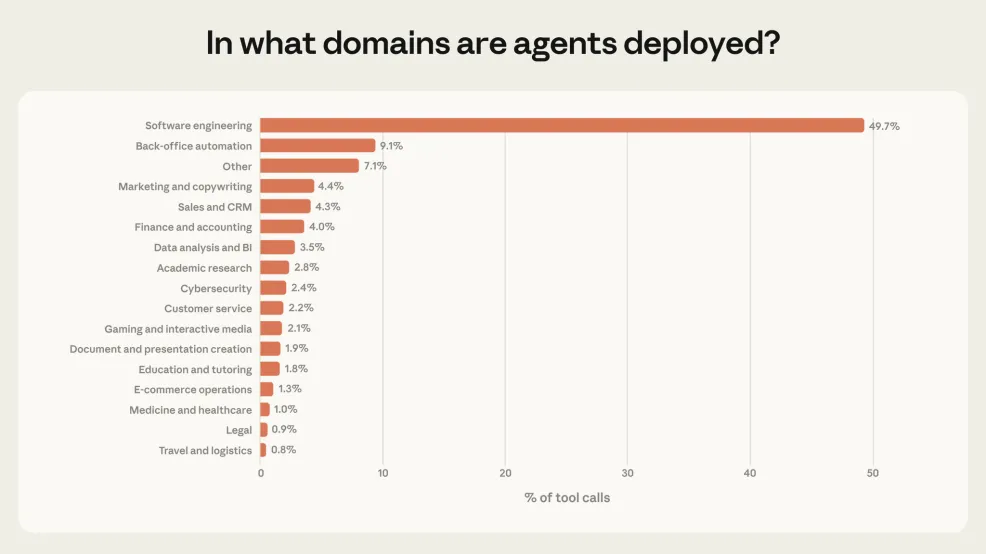
This chart comes from Anthropic’s new research paper, “Measuring AI agent autonomy in practice”, published this week. The team analysed millions of human-agent interactions across both Claude Code and Anthropic’s public API, studying individual tool calls as the building blocks of agent behaviour. The result? Software engineering accounts for 49.7% of all agentic activity. The next biggest category, back-office automation, manages just 9.1%. Everything else is in the low single digits. Customer service, a domain that has been talked about as a natural fit for AI agents for years, sits at just 2.2%, behind data analysis, cybersecurity, and even academic research.
The research also revealed that the longest autonomous Claude Code sessions nearly doubled in three months, from under 25 minutes to over 45 minutes. Experienced users auto-approve more actions but also interrupt more often, shifting from step-by-step approval to active monitoring. And Claude itself pauses to ask for clarification more than twice as often as humans interrupt it on complex tasks.
Weekly news roundup
This week’s AI landscape is dominated by the accelerating push toward autonomous agents — from OpenAI’s strategic hiring and device ambitions to new research on multi-agent cooperation — alongside growing tensions between AI companies and governments over military use, security, and workforce transformation.
AI business news
- OpenAI hires OpenClaw founder Peter Steinberger in push toward autonomous agents (Signals OpenAI’s deepening commitment to agentic AI, a key area for anyone building or deploying AI-powered workflows.)
- Altman-Amodei hand-holding snub goes viral at India AI event (A telling moment that underscores the intensifying rivalry between OpenAI and Anthropic as both compete for global influence and partnerships.)
- How AI is affecting productivity and jobs in Europe (Offers data-driven insight into AI’s real-world economic impact, essential reading for understanding workforce transformation trends.)
- Google launches Lyria 3 music generation model (Marks a significant step in generative AI for creative industries, raising fresh questions about copyright and the future of content creation.)
- OpenAI developing AI devices including smart speaker, The Information reports (Indicates OpenAI’s ambition to move beyond software into hardware, potentially reshaping how consumers interact with AI agents daily.)
AI governance news
- Pentagon officials threaten to blacklist Anthropic over its military chatbot policies (Highlights the escalating tension between AI safety principles and national security demands, a pivotal governance flashpoint.)
- Microsoft has a new plan to prove what’s real and what’s AI online (Addresses the critical challenge of AI-generated content authenticity, relevant to anyone concerned about misinformation and digital trust.)
- Accenture ‘links staff promotions to use of AI tools’ (A striking example of how organisations are beginning to formally incentivise AI adoption, with major implications for workplace culture and skills development.)
- European Parliament blocks AI on lawmakers’ devices, citing security risks (Demonstrates the growing institutional caution around AI data security, particularly in sensitive governmental contexts.)
- Announcing the NIST “AI agent standards initiative” for interoperable and secure innovation (A landmark move toward standardising AI agent interoperability and security, which will shape how multi-agent systems are built and deployed.)
AI research news
- Small reward models via backward inference (Proposes a more efficient approach to reward modelling, potentially making RLHF-style alignment more accessible for smaller teams and models.)
- Multi-agent cooperation through in-context co-player inference (Advances our understanding of how AI agents can collaborate dynamically, a foundational capability for real-world multi-agent deployments.)
- MAS-on-the-fly: dynamic adaptation of LLM-based multi-agent systems at test time (Introduces runtime adaptation for multi-agent systems, enabling more flexible and resilient agentic architectures.)
- Coding agent with lossless context management (Tackles one of the key practical bottlenecks in coding agents — context window limitations — with a lossless management approach.)
- Does socialisation emerge in AI agent society? A case study of Moltbook (Explores whether social behaviours emerge among interacting AI agents, raising fascinating questions about emergent properties in agent ecosystems.)
AI hardware news
- Nvidia CEO Jensen Huang claims company will unveil “a chip that will surprise people” at GTC next month (Builds anticipation for Nvidia’s next-generation silicon, which could reset performance expectations for AI training and inference.)
- Microsoft matches 100% of 2025 power use with renewables, with more than 40GW of contracted capacity (A major milestone in addressing AI’s enormous energy footprint, setting a benchmark for sustainable infrastructure at scale.)
- French AI cloud startup Policloud plans 1,000 sovereign micro-data centre deployments by 2030 (Reflects the growing European push for data sovereignty and distributed AI infrastructure as an alternative to hyperscaler dominance.)
- AMD underwrites $300m Crusoe loan so data centre firm can buy its AI chips (Shows AMD’s aggressive financing strategy to win AI data centre market share against Nvidia’s dominance.)
- Ericsson outlines AI vision ahead of 6G era (Previews how AI and next-generation connectivity will converge, with implications for edge computing and real-time AI applications.)