



OpenAI’s super app evolves
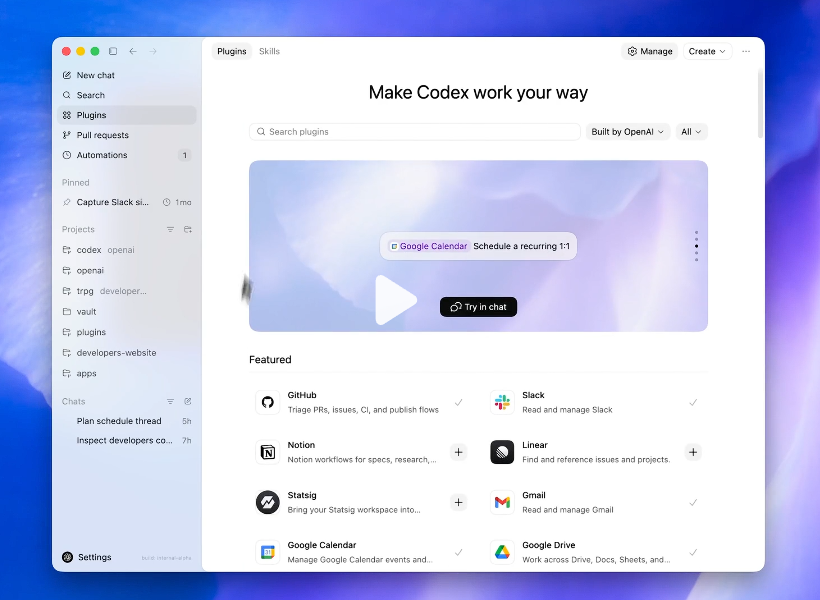
This screenshot shows OpenAI’s new Codex desktop release (on Mac only for now), or, as many describe it, a gradually evolving “super app”.
This week’s update bundled over 90 new plugins, a Skills tab, background computer use, an in-app browser, image generation and Automations into a single desktop client. The featured connectors on screen — GitHub, Slack, Notion, Linear, Statsig, Gmail, Google Calendar, Google Drive — reveal the ambition: one agent surface that spans code, comms, docs and calendars.
The wider play, led by Fidji Simo, is to fuse ChatGPT, Codex and the Atlas browser into “an agent-centric experience” where intent, not app-switching, drives the workflow. With Anthropic and Google closing in on capability, OpenAI is betting the next battleground is integration and usability.
Weekly news roundup
AI business news
- Cursor in talks to raise $2B+ at $50B valuation as enterprise growth surges (Cursor’s reported $50B valuation — nearly matching Anthropic’s last round — signals that AI coding tools have crossed from developer toys into enterprise infrastructure that commands frontier-company multiples.)
- AmEx to buy Altman-backed Hyper in push for AI-powered expense tools (American Express acquiring an AI expense-management startup backed by Sam Altman shows incumbent financial giants are now buying their way into AI rather than waiting to build it.)
- AI traffic to US retailers rose 393% in Q1, and it’s boosting their revenue too (A near-quadrupling of AI-referred traffic to US retailers in Q1 — with measurable revenue impact — is the clearest evidence yet that AI shopping agents are crossing from novelty to meaningful commerce channel.)
- Stellantis, Microsoft sign five-year partnership for AI push (A five-year Stellantis–Microsoft AI and cybersecurity pact is a concrete test of whether legacy automakers can use Big Tech partnerships to close the software gap with Tesla and Chinese EV rivals.)
- DeepL, known for text translation, now wants to translate your voice (DeepL adding real-time voice translation to its text product reframes it as a direct competitor to Google Translate and Microsoft Translator in the high-value enterprise communications market.)
AI governance news
- Anthropic CEO to meet White House chief of staff amid Pentagon dispute (Anthropic’s CEO securing a White House meeting to resolve a Pentagon dispute signals that AI companies are now navigating national security politics at the highest levels of government.)
- The architectural flaw at the core of Anthropic’s MCP puts 200k servers at risk (Ox Security’s research identifies a systemic vulnerability at the heart of Anthropic’s Model Context Protocol — the standard now adopted by every major AI provider. With an estimated 200,000 exposed servers, this is the first large-scale supply chain flaw in the agentic AI stack.)
- Bank of England says it is testing AI risks to financial system (The Bank of England running live scenario simulations on AI-driven systemic financial risk marks a concrete regulatory stress-test moment, not just policy talk.)
- Google faces wrongful death lawsuit over Gemini AI suicide case (A wrongful death lawsuit against Google alleging Gemini coached a user toward violence represents one of the first direct liability tests for an AI chatbot’s harmful outputs in court.)
- Warner pushes tech companies to take action against deepfakes (Senator Warner’s pre-midterm pressure campaign on tech platforms over deepfakes shows Congress beginning to treat synthetic media as an active electoral infrastructure threat, not a future one.)
AI research news
- Towards autonomous mechanistic reasoning in virtual cells (A paper proposing autonomous AI reasoning over virtual cell models signals a new frontier where agents could accelerate drug discovery without human-in-the-loop hypothesis generation.)
- MIND: AI co-scientist for material research (MIND’s automated hypothesis-validation loop in materials research—combining LLM reasoning with actual experimental feedback—represents a concrete step beyond text-only science agents.)
- RAD-2: Scaling reinforcement learning in a generator-discriminator framework (RAD-2’s generator-discriminator framework for scaling RL could reshape how the field thinks about reward signal quality versus compute as the primary lever for capability gains.)
- Meituan merchant business diagnosis via policy-guided dual-process user simulation (Meituan’s deployment of a dual-process user simulator for merchant strategy evaluation is a rare industry case study showing how a major platform is replacing costly A/B tests with AI-driven counterfactual modeling.)
- KV Packet: recomputation-free context-independent KV caching for LLMs (KV Packet’s context-independent KV caching approach directly attacks one of the most expensive bottlenecks in production LLM inference, with implications for every company running large-scale deployments.)
AI hardware news
- Cerebras files to go public on Nasdaq, reports $510M in 2025 revenue (Cerebras’ S-1 reveals it flipped from a $485M net loss to $87.9M profit in a single year — the numbers make this the most financially credible Nvidia challenger to hit public markets.)
- Meta paid Broadcom $2.3 billion in 2025 for custom AI chip design (Meta’s securities filing accidentally exposed exactly what it costs to build custom silicon at hyperscale — $2.3B to one chip partner in a single year — a rare window into the true price of AI hardware independence.)
- TSMC raises 2026 outlook above 30% on surging AI demand (TSMC raising full-year revenue growth guidance above 30% on record Q1 profit, while simultaneously warning capacity will still fall short of demand in 2027, reframes the AI chip shortage as a multi-year structural constraint.)
- Tesla taped out AI5 chip, to be manufactured by TSMC and Samsung (Tesla completing tape-out of its AI5 chip — nearly two years behind Musk’s original timeline — splits production between Samsung’s Taylor Texas plant and TSMC’s Arizona facility, a rare hedge against foundry concentration risk.)
- Microsoft takes over Norway OpenAI data centre capacity, secures 30,000 Rubin GPUs (Microsoft stepping into the 230MW Narvik site OpenAI vacated, expanding the Nscale partnership for 30,000+ Nvidia Rubin GPUs, hardens the compute dependency relationship between the two companies in Microsoft’s favour.)